
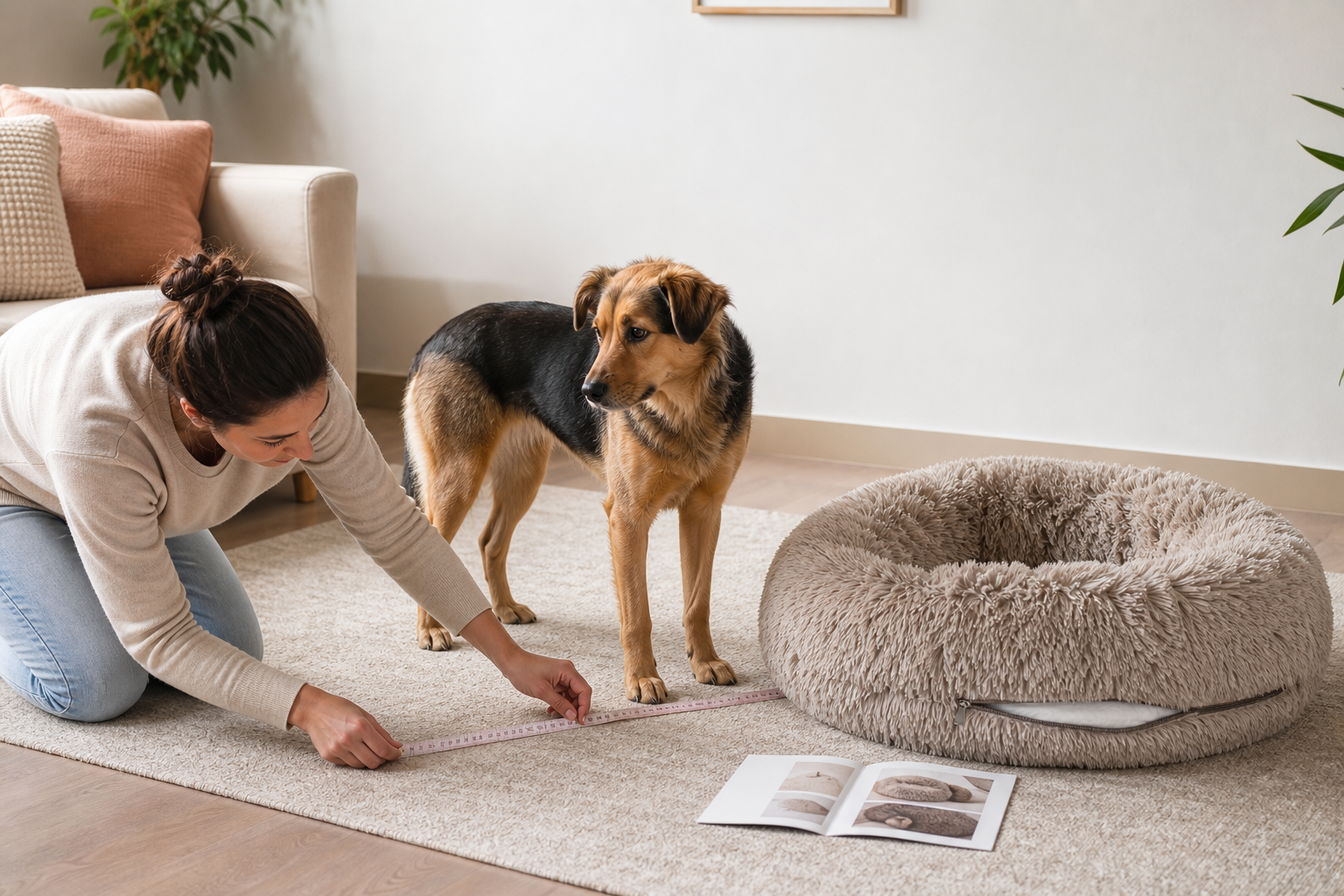
The short answer: choose a donut pet bed by measuring the space your dog or cat actually uses while resting, then comparing that number with the bed’s usable inner area—not only its outside diameter or an XS-to-XL label. Place it in a quiet, draught-free part of the home, verify exactly which components are washable, and let your pet investigate at their own pace.
A raised rim and soft fabric may appeal to pets that like to curl up, but a product name using “calming,” “anti-anxiety” or “orthopedic” does not prove a treatment effect. A retail bed cannot diagnose or treat anxiety, arthritis or pain. Persistent restlessness, sleep changes, stiffness, reluctance to lie down or other health concerns belong with a veterinarian.
Measure the sleeper before the bed
- Wait until your pet is resting naturally in a common position.
- For a curled sleeper, measure the widest area the curled body occupies.
- For a pet that sometimes stretches, measure from nose to the base of the tail and note the extra room used by legs.
- Add practical space for turning and repositioning.
- Compare with the listing’s inner sleeping area if supplied. If only outside diameter is shown, ask how much room the bolster removes.
Weight ranges can be a useful cross-check, but animals of the same weight can have very different body lengths. Measure every pet that may share the bed. A dog should not have to hang its head over the rim unless that is clearly a chosen, comfortable position, and a cat should have enough room to enter, turn and leave freely.
Donut-bed comparison checklist
| Listing detail | What to verify | Why it matters |
|---|---|---|
| Outside diameter | Inner sleeping diameter and bolster width | The rim reduces usable room |
| “Washable” | Whole bed, removable cover or separate insert | Cleaning methods are not interchangeable |
| Removable cover | Zipper location and whether the insert comes out | A hidden or absent closure changes the wash routine |
| Non-slip base | Current material and flooring compatibility | No base is slip-proof on every surface |
| “Calming” name | Construction and dimensions, not a treatment promise | Comfort preference differs by animal |
Compare the current donut-bed listings
The Plush Donut Dog Bed is one place to compare the current S-to-M size information and the exact machine-washing directions. For a wider advertised size range, review the Faux Fur Donut Dog Bed for XS to XL pets and check each variant’s dimensions rather than assuming the range applies to a single bed.
Another Faux Fur Donut Bed listing advertises sizes through XXL, while the Ultra Comfy Paws Dog & Cat Bed title mentions a removable washable cover. Those titles are starting points only. Confirm the selected variant, current size table, material, zipper, insert and care label before ordering.
Verify what “washable” means
Look for three separate facts: whether the outer cover detaches, whether the filling or insert is washable, and what washing and drying settings are permitted. A removable cover may tolerate a different process from the inner cushion. If the listing and sewn-in label differ, follow the product label or ask the seller before washing.
The U.S. Centers for Disease Control and Prevention advises following cleaning instructions on pet items and gives a general example of cleaning pet beds and blankets weekly, with more frequent attention when soiled, when a pet is sick or when vulnerable household members are present. That is general hygiene guidance, not a substitute for the bed’s material-specific limits or veterinary advice.
Choose a quiet, practical location
The RSPCA recommends a dog’s resting space be quiet, calm and away from draughts or frequent foot traffic. Put the bed on a level, dry floor where your pet can enter and leave without being cornered. Avoid blocking doors, stairs, radiators, fireplaces, heaters, cooling vents and household escape routes.
Check the floor grip with gentle hand pressure before use. Rugs, polished wood and tile behave differently, and a “non-slip” description is never an absolute guarantee. Keep the area free of cables and small items a pet could chew or swallow. If children or other animals share the home, make the bed a no-disturbance resting zone.
Introduce the bed gradually
- Set up the bed fully and allow manufacturing or packaging odours to dissipate in a ventilated, pet-safe area.
- Place it near a resting location your pet already chooses.
- Let your pet sniff and approach without being placed or held inside.
- Reward voluntary investigation with calm praise or a veterinarian-approved treat.
- Move a familiar washable blanket onto the bed if your pet likes it and the setup remains safe.
- Keep the previous resting option available during the transition.
Never punish avoidance or shut an unwilling pet into the bed. Some animals prefer a flat mat, cooler surface or firmer support. Preference is useful information, not disobedience. If a pet suddenly avoids all beds or struggles to settle, consult a veterinarian.
Daily and weekly safety checks
Before use, look for torn fabric, loose threads, exposed foam or filling, broken zippers and detached trim. Remove the bed if your pet chews or swallows material. Long faux fur can hide small objects, damp areas and parasites, so part the fibres during inspection.
Vacuum loose hair if allowed, clean spills promptly and dry every component completely before reassembly. Damp filling can develop odour and may support microbial growth. Wash hands after handling soiled pet bedding; CDC hygiene guidance notes that apparently healthy animals can still carry germs.
When comfort needs veterinary input
Older pets or animals with diagnosed mobility conditions may need a specific surface height, firmness and access route. “Orthopedic” is not a standardized promise that every pet will experience pain relief. Ask a veterinarian about sudden stiffness, crying when lying down, repeated repositioning, difficulty rising, weakness, incontinence or skin sores.
A deeply cushioned rim may not suit every pet. Watch entry and exit, breathing, body temperature and the ability to change position. Move the bed away from heat and stop use if your pet becomes trapped, overheated, distressed or begins destroying the materials.
Frequently asked questions
Should I size up a donut bed?
Use measured resting space and the bed’s inner dimensions. Size up when the current dimensions show the bolster would crowd normal turning or stretching, not as a universal rule.
Does a donut bed calm anxiety?
No bed can promise to treat anxiety. Some pets may enjoy a raised rim, while others prefer a mat or open surface. Discuss ongoing fear or anxiety behaviour with a veterinarian or qualified behaviour professional.
Can the entire bed go in a washing machine?
Only if the selected variant’s label explicitly permits it and the machine has suitable capacity. “Washable cover” does not mean the insert is machine washable.
Where should the bed go?
Choose a quiet, draught-free, low-traffic location away from heaters and hazards, while keeping entry and exit open.
How often should I replace it?
There is no fixed date. Replace it when damaged, permanently soiled, misshapen, no longer supportive for your pet’s normal rest, or impossible to clean as directed.
Bottom line
Measure the animal’s real resting footprint, verify usable inner dimensions and care instructions, place the bed in a calm and safe location, then allow voluntary exploration. Judge the bed by fit, condition and your pet’s behaviour—not unverified calming or orthopedic promises.